Medical Imaging · Optimization · Machine Learning

Hengjie Liu

Postdoctoral Scholar · UCSF Radiation Oncology

I am a Postdoctoral Scholar in Radiation Oncology at the University of California, San Francisco. I received my Ph.D. in Physics & Biology in Medicine from UCLA, supervised by Prof. Ke Sheng and Prof. Dan Ruan, and my B.S. in Engineering Physics from Tsinghua University. My research broadly focuses on computational methods for medical imaging and their clinical applications.

My research training has spanned two fairly different areas. I spent about four years working on MRI physics, acquisition, and reconstruction, including pulse-sequence programming, 4D cardiac MRI, 4D flow MRI, and low-field portable and programmable MRI systems. I subsequently transitioned into deformable image registration, where I have spent about five years working on both learning- and optimization-based methods, with an emphasis on registration-specific designs, multimodal registration, anatomically plausible deformation and clinically relevant registration problems. Moving between these areas required me to quickly learn new tools, methods, and ways of thinking, and has made me comfortable working across disciplinary boundaries.

My background in physics, imaging-system design, pulse-sequence development, and conventional optimization-based image reconstruction continues to shape how I approach modern machine-learning problems. Rather than viewing a new model primarily through the lens of architectural complexity, I tend to ask what makes the underlying problem difficult, what prior knowledge is available, and how that knowledge can be incorporated into the method. This perspective has strongly influenced my work in deformable image registration, where I am particularly interested in understanding why a method works, identifying the right inductive biases for the problem, and using them to build methods that are both effective and meaningful for real medical-imaging tasks.

More broadly, I am interested in problems at the intersection of medical imaging, machine learning, numerical optimization, and imaging physics. I enjoy learning new areas and working on problems where ideas from different fields can be brought together to better understand and solve a practical imaging problem.

Technical Skills

Skills

Machine Learning & Optimization

Deep learningMultimodal learningDomain generalizationNumerical optimizationSparse & low-rank modeling

Medical Image Analysis

Deformable image registrationRadiation therapyCTMRISegmentationClassification

MRI

Image reconstructionPulse-sequence programming4D MRI4D flow MRIMotion management (cardiac and abodominal)

Programming & Tools

PythonPyTorchMATLABC++LinuxGitDockerSiemens IDEA

Research Highlights

Projects

Visualization of MUSA head-and-neck deformable registration and Jacobian determinant

Medical Image Analysis, 2025

MUSA (MUsculo-Skeleton-Aware)

Anatomically Guided Head-and-Neck CT Deformable Registration

MUsculo-Skeleton-Aware (MUSA) is a two-stage registration framework designed for large and anatomically complex head-and-neck deformation.
  • Uses anatomical information to encourage different deformation behavior in bony structures and soft tissue. Decomposes deformation into a bulk posture change and residual fine deformation.
  • Emphasizes deformation plausibility in addition to registration accuracy.
  • Designed to be architecture-agnostic and can be flexibly integrated with different neural network backbones.
Overview of controlled deformable registration experiments Summary table of registration experiment results

Medical Imaging with Deep Learning — Short Papers, 2025

Registration-Specific Design Before Architectural Complexity

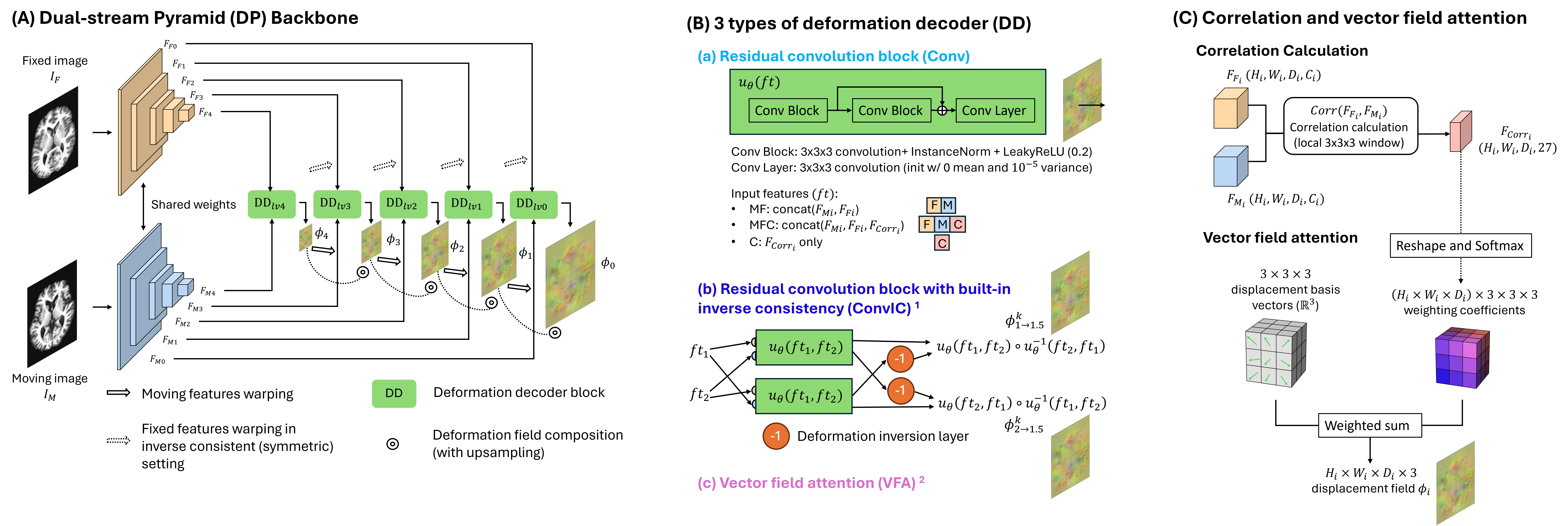
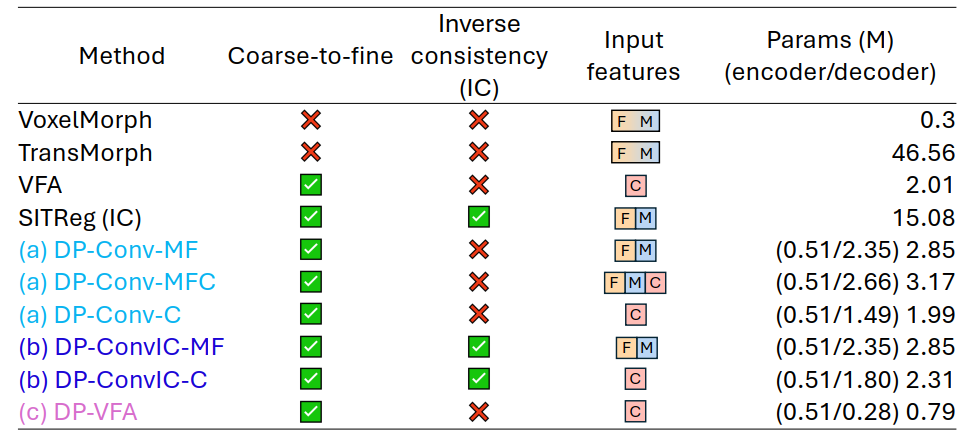
Unsupervised Deformable Image Registration Revisited

This project studies which registration-specific design choices are most important for learning-based deformable image registration.
  • Evaluates multi-resolution estimation, local correlation, and inverse-consistency constraints in controlled experiments.
  • Shows that relatively simple network architectures can remain competitive when the registration formulation is designed carefully.
  • Includes validation across three Learn2Reg tasks: brain MR-MR (OASIS and LUMIR) and abdominal CT-CT.
Overview of continuous deformable image registration methods and deformation priors Comparison of continuous deformable registration performance across motion regimes

MICCAI 2026 Off-Grid Workshop — Oral

The Right Prior for the Right Deformation

Rethinking Continuous Deformable Image Registration

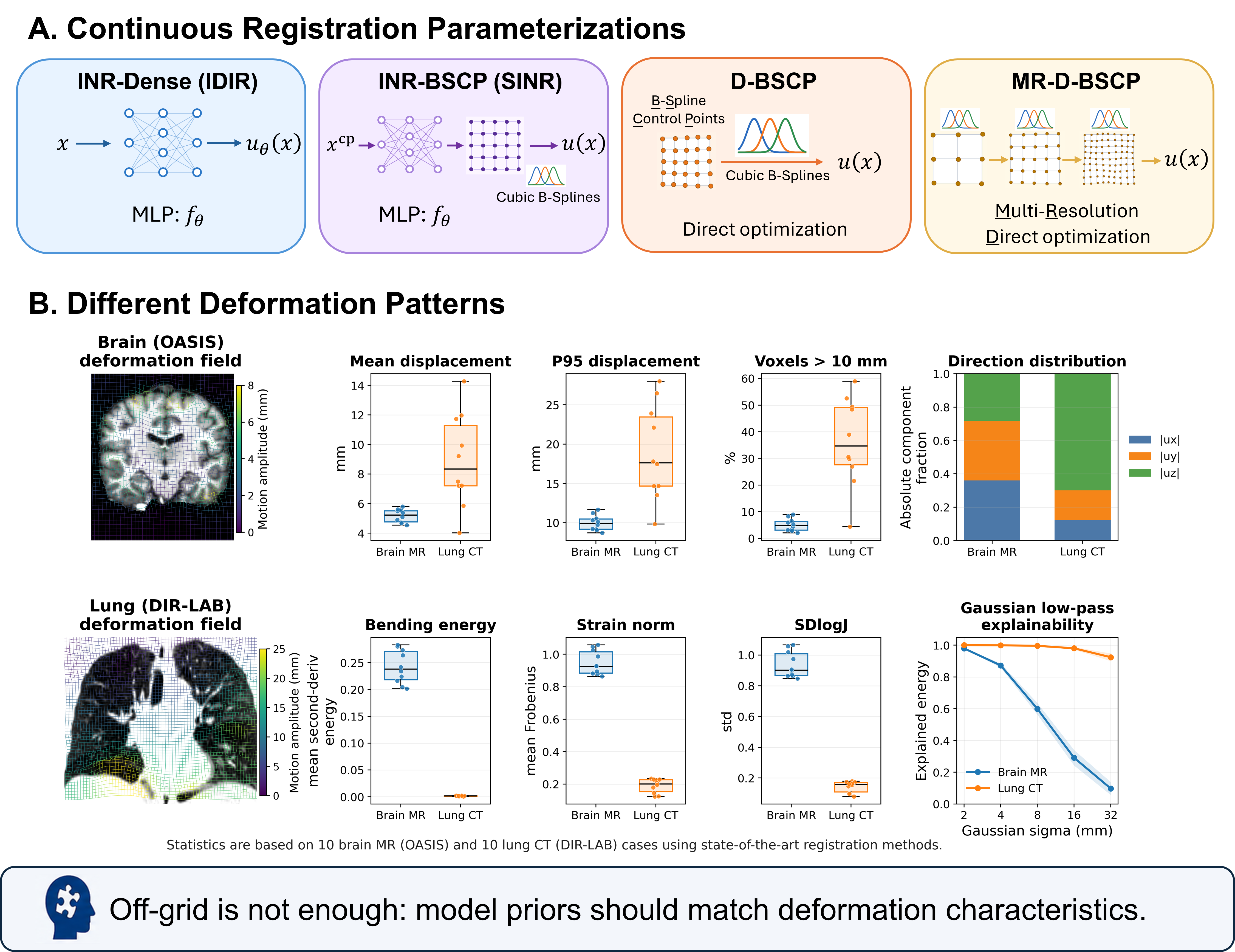
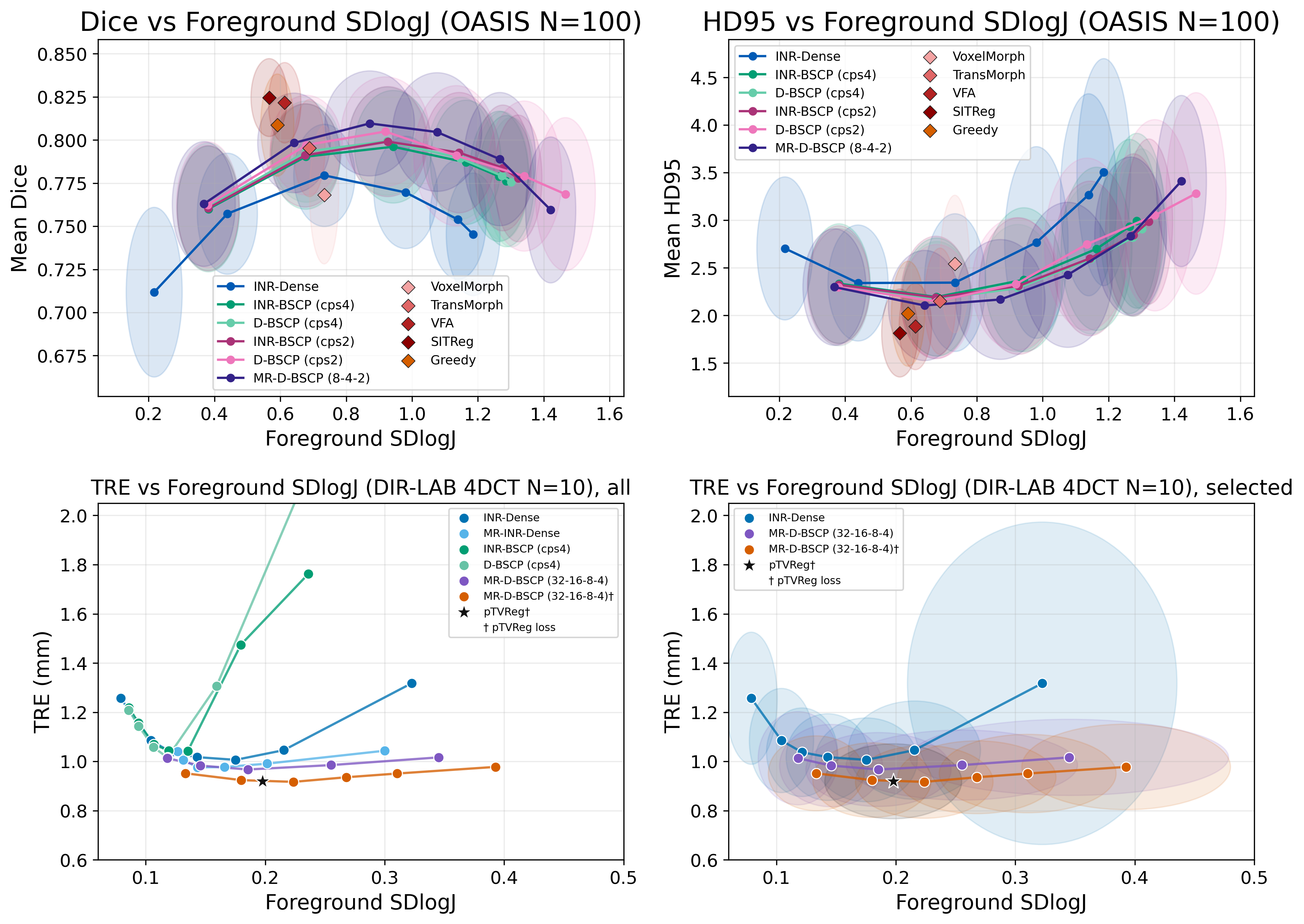
This work studies continuous deformable image registration from a prior-matching perspective: registration performance depends not simply on using an off-grid or neural representation, but on whether the deformation prior induced by the parameterization and optimization matches the target motion.

  • We compare INR-Dense, INR-BSCP, D-BSCP, and MR-D-BSCP across two distinct regimes: inter-subject brain MRI on OASIS, with moderate but locally complex anatomical deformation, and intra-subject exhale-to-inhale lung CT on DIR-LAB 4DCT, with larger, smoother, and more directionally coherent respiratory motion.
  • On OASIS, directly optimized B-Spline control points closely match INR-BSCP, indicating that much of INR-BSCP’s effectiveness comes from the locality, smoothness, and scale of the B-Spline parameterization, rather than the INR alone. INR-Dense instead favors a smoother deformation regime and is less effective at capturing complex local variation.
  • On DIR-LAB, single-scale B-Spline methods are less robust to large respiratory motion. INR-Dense benefits from its smooth, coherent INR prior, while MR-D-BSCP uses coarse-to-fine optimization to capture large displacement before local refinement, achieving the strongest performance among the tested continuous parameterizations.
  • We evaluate methods across the alignment–regularity trade-off, rather than at a single regularization setting, to enable fairer comparisons across deformation models.

Selected Publications

Publications

  1. H Liu, E McKenzie, D Xu, Q Xu, RK Chin, D Ruan, K Sheng. MUsculo-Skeleton-Aware (MUSA) deep learning for anatomically guided head-and-neck CT deformable registration. Medical Image Analysis, 2025.
  2. H Liu, C Shen, D Ruan, K Sheng. The Right Prior for the Right Deformation: Rethinking Continuous Deformable Image Registration. MICCAI Workshop Off-Grid: 1st Workshop on Continuous Representations and Grid-Free Methods in Medical Imaging, 2026.
  3. H Liu, Y Dou, D Xu, X Fu, D Ruan, K Sheng. Zero-Shot Multi-Contrast Brain MRI Registration by Intensity Randomizing T1-Weighted MRI. International Challenge on Medical Image Registration (Learn2Reg), MICCAI, 2025.
  4. H Liu, D Ruan, K Sheng. Unsupervised Deformable Image Registration Revisited: Enhancing Performance with Registration-Specific Designs. Medical Imaging with Deep Learning – Short Papers, 2025.
  5. C Shen, H Liu, D Ruan, D Li. Population-Prior-Assisted Implicit Neural Representations for Instance-Specific Unsupervised Accelerated MRI Reconstruction. 2026 IEEE 23rd International Symposium on Biomedical Imaging (ISBI), 2026.
  6. E Nguyen, H Liu, D Ruan. Necessity and impact of specialization of large foundation model for medical segmentation tasks. Medical Physics, 2024.
  7. H Li, YH Tsai, H Liu, D Ruan. Metric learning guided sinogram denoising for cone beam CT enhancement. Medical Physics, 2024.
  8. A Li, Q Lyu, S Jing, H Liu, C Frank, L Jiang, D Ruan, K Sheng. A Hybrid Sparse Primary Sampling (SPS) Strategy for CBCT. IEEE Transactions on Biomedical Engineering, 2025.
  9. D Xu, H Liu, X Miao, …, K Sheng. Accelerated Patient-specific Non-Cartesian MRI Reconstruction using Implicit Neural Representations. International Journal of Radiation Oncology Biology Physics, 2025.
  10. D Xu, Y Yang, H Liu, …, K Sheng. TomoGRAF: An X-ray physics-driven generative radiance field framework for extremely sparse view CT reconstruction. Plos one, 2025.
  11. D Xu, M Descovich, H Liu, K Sheng. Robust localization of poorly visible tumor in fiducial-free stereotactic body radiation therapy. Radiotherapy and Oncology, 2024.
  12. D Xu, M Descovich, H Liu, Y Lao, AR Gottschalk, K Sheng. Deep match: A zero-shot framework for improved fiducial-free respiratory motion tracking. Radiotherapy and Oncology, 2024.
  13. D Xu, X Miao, H Liu, …, K Sheng. Paired conditional generative adversarial network for highly accelerated liver 4D MRI. Physics in Medicine and Biology, 2024.
  14. D Xu, H Liu, D Ruan, K Sheng. Learning Dynamic MRI Reconstruction with Convolutional Network Assisted Reconstruction Swin Transformer. International Conference on Medical Image Computing and Computer-Assisted Intervention 2023 (Workshops).
  15. P Rezapoor, J Pham, B Neilsen, H Liu, … D Ruan. A clustering‐based approach to address correlated features in predicting genitourinary toxicity from MRI‐guided prostate SBRT. Medical Physics, 2025.
  16. J Pham, BK Neilsen, H Liu, …, D Ruan. Dosimetric predictors for genitourinary toxicity in MR‐guided stereotactic body radiation therapy (SBRT): Substructure with fraction‐wise analysis. Medical Physics, 2024.
  17. P Ramesh, H Liu, W Gu, K Sheng. Fixed beamline optimization for intensity-modulated carbon-ion therapy. IEEE Transactions on Radiation and Plasma Medical Sciences, 2021.